
How to Get Your First Freelance Client in the USA With No Experience

Introduction
Freelancing has become one of the fastest-growing ways to earn income in the United States. Today, businesses of all sizes hire independent professionals for services such as content writing, graphic design, web development, SEO, video editing, social media management, virtual assistance, and many other digital services.
For many people, freelancing offers more than just extra income.
It offers flexibility.
The ability to work remotely.
The freedom to choose projects that match your interests and career goals.
For some, it even becomes a long-term alternative to the traditional 9-to-5 job.
Yet despite the growing opportunities, nearly every beginner faces the same challenge:
Getting that first client.
Learning a skill is often the easy part.
Finding someone willing to pay for that skill is where most beginners struggle.
You may spend weeks improving your abilities, creating portfolio samples, and setting up profiles on freelance platforms.
Many beginners start by creating accounts on Fiverr and Upwork. If you’re still working on your setup, check out How to Create a Fiverr Gig for Beginners in 2026 and How to Create an Upwork Profile That Wins Clients (2026 Beginner Guide) to build a stronger foundation.
At first, everything feels exciting.
Then reality sets in.
Your Fiverr gig gets few impressions.
Your Upwork proposals go unanswered.
People visit your profile but never reach out.
Days turn into weeks.
Before long, doubt starts creeping in.
You may begin asking yourself:
- Am I skilled enough?
- Is freelancing too competitive?
- Did I choose the wrong niche?
- Can beginners actually succeed?
- How do people land their first paying client?
If you’ve asked yourself these questions, you’re far from alone.
Nearly every successful freelancer has experienced the same uncertainty at some point.
The truth is that most beginners don’t struggle because they lack talent.
They struggle because they haven’t yet learned how clients make hiring decisions.
The good news?
Every successful freelancer started from zero.
No reviews.
No testimonials.
No client history.
No reputation.
No social proof.
Yet many eventually built thriving freelance businesses and long-term careers.
The difference wasn’t luck.
It was a combination of persistence, positioning, communication, and continuous improvement.
Even if you’re starting with no professional experience, no client history, and no reviews, the strategies in this guide can help you build credibility, earn trust, and land your first freelance client in the USA.
In the sections below, you’ll learn practical strategies for finding clients, building trust, and creating opportunities that can help launch your freelance career.
Why Getting Your First Freelance Client Feels So Difficult Without Experience

One of the biggest challenges beginners face is what’s often called the experience paradox.
Clients want freelancers with experience.
But freelancers need clients to gain experience.
At first glance, it feels impossible.
How can you build experience if nobody hires you?
Fortunately, most hiring decisions aren’t based entirely on experience.
Many business owners, startup founders, bloggers, coaches, and entrepreneurs aren’t necessarily looking for the most experienced freelancer available.
They’re looking for someone they trust.
That’s an important distinction.
When evaluating freelancers, clients often ask themselves questions like:
- Can this person solve my problem?
- Do they understand my goals?
- Will communication be easy?
- Can I rely on them?
- Will they deliver quality work?
- Can they meet deadlines?
Notice something important.
Most of these questions have very little to do with years of experience.
They’re trust-based questions.
A beginner who communicates clearly, responds quickly, and presents strong portfolio samples can often outperform a more experienced freelancer who fails to do those things well.
That’s why your goal isn’t to appear like someone with twenty years of experience.
Your goal is to make potential clients feel confident about hiring you.
Once you understand that principle, finding freelance opportunities becomes significantly easier.
Common Mistakes That Prevent Beginners From Getting Hired

Many new freelancers unknowingly make mistakes that reduce their chances of landing projects.
The good news?
Most of these mistakes are completely avoidable.
Trying to Offer Too Many Services
One of the most common beginner mistakes is trying to offer everything.
A profile might say:
“I provide content writing, SEO, social media marketing, graphic design, video editing, web development, virtual assistance, and digital marketing services.”
While that may sound impressive, it usually creates confusion.
Businesses generally prefer specialists.
Before choosing a service, it’s important to understand which skills are currently in demand. Our guide on Best Digital Skills to Learn in 2026 for Beginners in the USA can help you identify profitable freelance skills that clients are actively seeking.
Think about it this way:
If you needed heart surgery, would you choose a general practitioner or a heart surgeon?
The same principle applies to freelancing.
Companies looking for SEO help want an SEO specialist.
Businesses seeking blog content want a writer.
Brands that need visual assets want a designer.
The more specific your positioning becomes, the easier it is for potential clients to understand your value.
Instead of saying:
“I help businesses grow online.”
Try:
“I help small businesses increase organic traffic through SEO-focused content.”
The second statement is clearer, more specific, and much easier to trust.
Waiting Until Everything Is Perfect
Many beginners spend months preparing.
They take another course.
Update their portfolio.
Rewrite their profile.
Watch more tutorials.
Then repeat the process again.
Meanwhile, they never apply for actual projects.
This is a form of procrastination that often feels productive.
The reality is simple:
You don’t become ready through endless preparation.
You become ready through action.
Every proposal teaches you something.
Every client conversation reveals new insights.
Every project helps improve your skills.
Real-world experience is often the best teacher.
Sending Generic Proposals
Another common mistake is sending the same proposal to every project.
For example:
“Hello Sir, I can do this project perfectly. Please hire me.”
Messages like this rarely get responses.
Clients receive dozens of nearly identical applications.
Generic proposals signal low effort.
Strong proposals focus on the client’s goals rather than the freelancer’s needs.
People hire solutions.
Not promises.
The more clearly you demonstrate that you understand a client’s problem, the more likely you are to stand out from the competition.
Step 1: Choose One Service and One Target Market

One of the fastest ways to improve your chances of getting hired is to gain clarity.
Many beginners try to target everyone.
Unfortunately, when you target everyone, you usually attract nobody.
Start by answering two simple questions.
What Service Do You Offer?
Choose one primary service.
Examples include:
- Content Writing
- SEO Writing
- Graphic Design
- Video Editing
- Website Development
- Virtual Assistance
- Social Media Management
- Email Marketing
If you’re still unsure which service to offer, check out Best Digital Skills to Learn in 2026 for Beginners in the USA to discover beginner-friendly skills with strong earning potential.
Can you expand later?
Absolutely.
But when you’re just getting started, it’s much easier to build momentum when you’re known for one thing.
Specialization creates recognition.
Who Do You Help?
Next, identify your ideal audience.
Examples include:
- Small businesses
- Startups
- Bloggers
- Coaches
- Real estate professionals
- E-commerce brands
- Local businesses
Specific positioning leads to stronger marketing messages.
For example:
Weak positioning:
“I build websites.”
Stronger positioning:
“I build lead-generating websites for local service businesses across the United States.”
The second statement immediately communicates value and purpose.
Potential clients can instantly understand who it’s for and why it matters.
The more specific you become, the easier it becomes to attract the right clients.
Step 2: Build Portfolio Samples Before Looking for Clients

One of the biggest freelancing myths is that you need clients before creating a portfolio.
In reality, most freelancers need a portfolio before businesses feel comfortable hiring them.
A portfolio provides proof.
Proof reduces risk.
Reduced risk builds trust.
And trust increases the likelihood of getting hired.
The good news?
Your portfolio pieces don’t need to come from paid projects.
You can create them yourself.
For Writers
Create:
- Blog articles
- SEO content
- Product descriptions
- Website copy
- Email newsletters
For Graphic Designers
Create:
- Logo concepts
- Brand identity projects
- Social media graphics
- Advertising creatives
- Marketing materials
For Video Editors
Create:
- YouTube videos
- Promotional content
- Instagram Reels
- TikTok edits
- Business advertisements
For Web Developers
Create:
- Landing pages
- Portfolio websites
- Small business websites
- E-commerce mockups
- Practice projects
Three outstanding samples are often more valuable than twenty average ones.
Focus on quality over quantity.
Remember:
Your portfolio doesn’t need to prove you’ve worked with clients.
It simply needs to prove you can do the work.
When potential clients see strong samples, they’re much more likely to trust your abilities—even if you’re just getting started.
Step 3: Create a Professional Freelance Profile

Your profile is your online storefront.
Before someone contacts you, they’re evaluating your profile.
In many cases, that first impression determines whether they continue reading or move on to another freelancer.
If you’re using Upwork to find clients, our guide on How to Create an Upwork Profile That Wins Clients (2026 Beginner Guide) will help you build a profile that attracts more invitations and client inquiries.
A strong profile should immediately answer three questions:
What Do You Do?
Clearly define your service.
Who Do You Help?
Identify your target audience.
Why Should Someone Hire You?
Explain the result you help clients achieve.
Your profile should include:
✅ A professional profile photo
✅ A clear headline
✅ A detailed service description
✅ Portfolio samples
✅ Relevant skills
✅ Professional communication
Example Headline
SEO Content Writer Helping Small Businesses Increase Organic Traffic and Generate More Leads
This headline is:
- Clear
- Specific
- Outcome-focused
- Easy to understand
That’s exactly what potential clients want to see.
Avoid vague headlines like:
- Digital Expert
- Online Marketing Professional
- Freelancer Available
These don’t tell clients what you actually do.
Clarity wins.
Always.
Step 4: Understand How Clients Actually Think
One of the biggest mindset shifts in freelancing is realizing that clients rarely buy services.
They buy outcomes.
A business owner isn’t buying blog posts.
They’re buying website traffic.
An e-commerce store isn’t buying graphic design.
They’re buying more sales.
A local business isn’t buying SEO.
They’re buying visibility, leads, and customers.
Freelancers who understand this concept often win more projects because they focus on results instead of features.
Instead of saying:
“I write blog articles.”
Say:
“I create SEO-focused content designed to attract targeted visitors and improve search visibility.”
The second statement highlights the value behind the service.
And value is ultimately what clients pay for.
Think Like a Business Owner
Whenever you’re communicating with a potential client, ask yourself:
“What outcome does this person really want?”
For example:
| Service | What the Client Actually Wants |
|---|---|
| Content Writing | More traffic and leads |
| SEO | Higher search rankings |
| Graphic Design | More engagement and sales |
| Video Editing | Increased views and conversions |
| Website Development | More customers and inquiries |
| Social Media Management | Stronger brand awareness |
The more you connect your service to a business result, the more attractive your offer becomes.
Shift Your Messaging
Instead of focusing entirely on what you do, focus on what clients gain.
Compare these examples:
❌ “I create websites.”
✅ “I build websites that help local businesses generate more leads.”
❌ “I write articles.”
✅ “I write SEO-focused content that helps businesses attract qualified visitors from Google.”
❌ “I manage social media.”
✅ “I help brands build an engaged audience and increase customer trust through strategic social media content.”
This small shift can dramatically improve how potential clients perceive your value.
Because at the end of the day, clients care less about your process and more about the results you can help them achieve.
That’s one of the most important lessons every successful freelancer eventually learns.
Step 5: Write Personalized Proposals That Get Responses
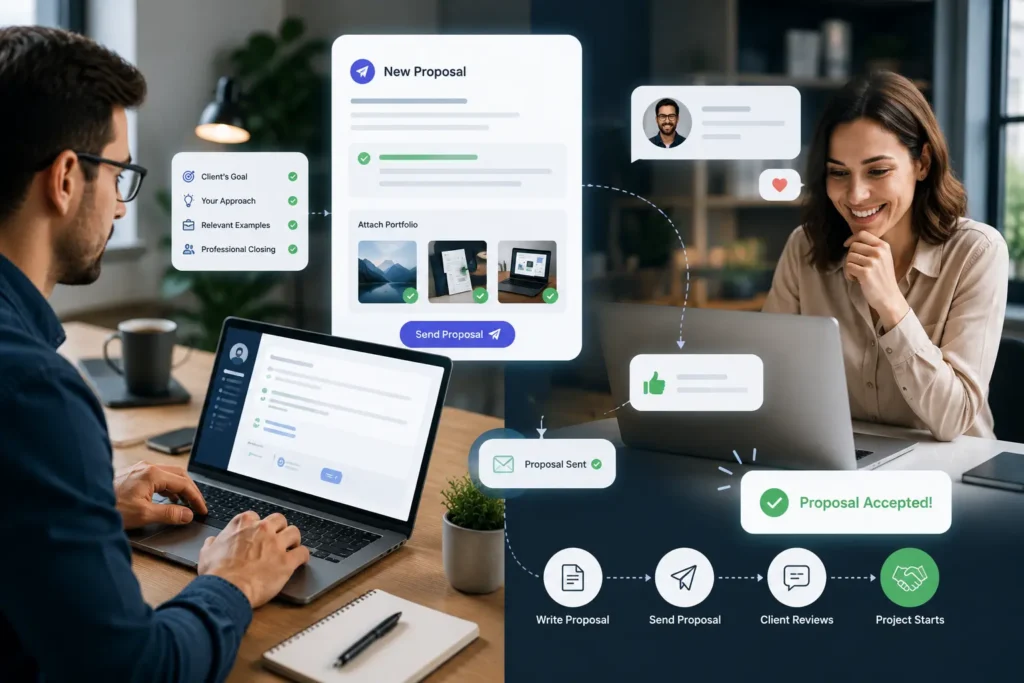
Your proposal is often the first direct interaction between you and a potential client.
Unfortunately, many beginners make the mistake of sending the same proposal to every job posting.
Clients can spot a copy-and-paste application almost instantly.
And when they do, they usually move on.
The purpose of a proposal isn’t to impress someone with complicated language.
It’s to show that you understand the project, recognize the client’s goals, and can help achieve the desired outcome.
A strong proposal usually includes four key elements.
1. Acknowledge the Client's Goal
Show that you’ve carefully read the project description.
For example:
“I noticed you’re looking for SEO-focused blog content to help increase organic traffic to your small business website.”
This immediately demonstrates attention to detail and genuine interest in the project.
Clients appreciate freelancers who take the time to understand their needs.
2. Explain How You Can Help
Briefly explain your approach.
Keep the focus on the client’s objectives rather than your personal background.
Remember:
Clients care more about solving their problem than hearing your life story.
Focus on the outcome you can help them achieve.
3. Share Relevant Examples
Portfolio samples reduce uncertainty.
Whenever possible, include examples that closely match the project requirements.
Even self-created portfolio pieces can help build credibility when they’re relevant and professionally presented.
4. End Professionally
Invite the client to continue the conversation.
Keep your closing simple, confident, and professional.
Example Proposal
Hello,
I noticed you’re looking for SEO-focused blog content to help increase organic traffic to your website.
I’ve created similar content designed to improve search visibility while providing value to readers. I’d be happy to share relevant writing samples and learn more about your goals.
Thank you for your time, and I look forward to hearing from you.
Best regards,
Your Name
Simple.
Professional.
Client-focused.
That’s exactly what many businesses want to see.
Step 6: Build Trust Even Without Reviews
One of the biggest concerns among beginner freelancers is the lack of reviews.
Many assume clients only hire freelancers with dozens—or even hundreds—of positive ratings.
That’s simply not true.
Every successful freelancer started with zero reviews.
The goal isn’t to hide your lack of reviews.
The goal is to replace them with credibility.
Complete Your Profile
An incomplete profile creates doubt.
A complete profile creates confidence.
Make sure your profile includes:
- A professional profile photo
- A clear headline
- A detailed service description
- Relevant skills
- Portfolio samples
- Professional formatting
If you’re using Upwork, optimizing every section of your profile can significantly improve your credibility. Learn more in How to Create an Upwork Profile That Wins Clients (2026 Beginner Guide).
Small improvements can have a major impact on how potential clients perceive you.
Communicate Professionally
Many freelancers underestimate the importance of communication.
Clients notice things such as:
- Response speed
- Grammar and spelling
- Clarity
- Attention to detail
- Professionalism
Strong communication often helps beginners compete with freelancers who have significantly more experience.
People enjoy working with professionals who make projects easier—not harder.
Be Reliable
Reliability is one of the most valuable skills in freelancing.
If you promise a deadline, meet it.
If you say you’ll send an update tomorrow, send it tomorrow.
If an issue arises, communicate early.
Trust is built through consistency.
And consistency often leads to repeat business, referrals, and long-term client relationships.
Step 7: Apply Consistently and Track Your Progress
Many beginners quit too early.
They send a handful of proposals.
Receive no responses.
Then assume freelancing doesn’t work.
The reality is very different.
Finding your first paying client often requires patience, persistence, and continuous improvement.
A realistic journey might look something like this:
- First 20 proposals → No replies
- Next 20 proposals → Profile views
- Next 20 proposals → Client conversations
- Next 20 proposals → Interviews
- Next 20 proposals → First project
Everyone’s timeline is different.
What matters most is staying active and learning from feedback.
Successful freelancers aren’t people who never face rejection.
They’re people who keep moving forward despite it.
Track Your Results
Many freelancers send proposals without tracking what happens afterward.
This makes improvement difficult.
Consider tracking:
- Number of proposals sent
- Response rate
- Interview invitations
- Client conversations
- Projects won
Over time, patterns will begin to emerge.
You’ll discover:
- Which proposals perform best
- Which services attract attention
- Which portfolio samples generate interest
- Which industries respond most frequently
Small improvements can produce significant results over time.
Focus on Progress, Not Perfection
Your first proposal probably won’t be perfect.
Neither will your second.
Or your tenth.
That’s okay.
Every successful freelancer improves through repetition and experience.
Progress matters far more than perfection.
The freelancer who sends 100 thoughtful proposals will almost always outperform the freelancer who spends months endlessly preparing.
Action creates momentum.
Momentum creates opportunities.
Remember Why You Started
There will be days when freelancing feels frustrating.
You’ll face rejection.
You’ll experience setbacks.
You’ll question whether it’s worth continuing.
That’s normal.
Every successful freelancer has faced the same challenges.
The key difference is that they kept going.
If you’re still in the early stages of your journey, our complete guide on How to Start Freelancing in the USA: A Complete Beginner’s Guide (2026) provides a step-by-step roadmap for building a sustainable freelance career from the ground up.
Stay patient.
Stay professional.
Stay consistent.
Your first client may be much closer than you think.
How to Stand Out in a Competitive Freelance Market
Freelancing is competitive.
There’s no point pretending otherwise.
However, most freelancers make the same mistakes.
That creates opportunities for those willing to approach freelancing differently.
The goal isn’t to compete with everyone.
The goal is to become the obvious choice for a specific type of client.
Develop a Personal Brand
People remember individuals.
Not generic profiles.
Use a professional profile photo, consistent messaging, and a clear service description across every platform you use.
Over time, familiarity builds trust.
And trust often leads to opportunities.
Your personal brand doesn’t need to be complicated.
It simply needs to communicate:
- Who you help
- What you do
- Why clients should choose you
Consistency matters.
Whether someone finds you on Fiverr, Upwork, LinkedIn, or your personal website, your message should remain clear and professional.
Focus on a Specific Niche
Specialists often earn more than generalists because their expertise is easier to understand.
Instead of saying:
“I write content for everyone.”
Try:
“I create SEO-focused blog content for small businesses in the United States.”
Specific positioning makes marketing easier and helps you stand out from competitors.
When clients immediately recognize that your services fit their needs, they’re much more likely to contact you.
Continuously Improve Your Portfolio
Your portfolio should evolve as your skills improve.
Every few months, review your samples.
Replace weaker work with stronger examples.
A high-quality portfolio often becomes your most powerful sales tool.
Clients want proof.
The better your portfolio becomes, the easier it is to build trust.
Stay Visible
Many freelancers create a profile and then wait.
Successful freelancers create opportunities.
Continue:
- Applying for projects
- Networking with professionals
- Updating your portfolio
- Learning new skills
- Sharing valuable content
Momentum compounds over time.
The more visible you become, the more opportunities you’ll create for yourself.
Best Places to Find Your First Freelance Client

Finding your first client becomes much easier when you’re searching in the right places.
Fortunately, beginners have several excellent options available.
Fiverr
Fiverr remains one of the most beginner-friendly freelance platforms available.
Instead of applying for jobs, freelancers create service listings known as gigs.
Potential buyers then discover those services through Fiverr’s search system.
If you’re new to the platform, our guide on How to Create a Fiverr Gig for Beginners in 2026 will show you how to build a professional gig that attracts buyers and generates more visibility.
Fiverr Tips
- Focus on one primary service
- Create professional gig images
- Use relevant keywords naturally
- Write benefit-driven descriptions
- Add portfolio samples
- Respond quickly to inquiries
- Continuously improve your gig
Many freelancers earn their first online income through Fiverr because buyers are already searching for solutions.
The key is creating a professional profile that clearly communicates value.
Upwork
Upwork works differently.
Instead of waiting for buyers to find you, freelancers actively apply for projects posted by businesses.
This allows you to target opportunities that closely match your skills and interests.
To maximize your chances of success, make sure your profile is optimized using How to Create an Upwork Profile That Wins Clients (2026 Beginner Guide).
A strong profile can significantly increase your visibility and improve response rates.
Upwork Tips
- Apply only for relevant projects
- Personalize every proposal
- Keep applications concise
- Include portfolio samples
- Read project descriptions carefully
- Apply consistently
Most Upwork success comes from persistence rather than immediate results.
Many freelancers receive dozens of rejections before landing their first project.
That’s completely normal.
Fiverr vs Upwork: Which Platform Is Better?
Many beginners ask the same question:
Should I start with Fiverr or Upwork?
The answer depends on your goals, skills, and preferred working style.
Fiverr allows clients to discover your services.
Upwork allows you to actively pursue opportunities.
Both platforms can be excellent choices.
If you’re unsure which one fits your situation best, read Fiverr vs Upwork (2026): Which Freelance Platform Is Best for Beginners? for a detailed comparison.
Many successful freelancers eventually use both platforms to diversify their income sources.
Many beginners overlook LinkedIn.
That’s a mistake.
Business owners, startup founders, marketing managers, and entrepreneurs use LinkedIn every day.
Many hire freelancers directly without ever posting a public job listing.
LinkedIn Tips
- Create a professional profile
- Use a clear headline
- Share useful content
- Participate in industry discussions
- Build meaningful connections
- Demonstrate expertise consistently
Unlike freelance marketplaces, LinkedIn helps you build long-term professional relationships.
Over time, it can become one of your most valuable sources of freelance leads.
Local Businesses
Local businesses are often an overlooked opportunity.
Many need help with:
- Website management
- SEO
- Content creation
- Social media management
- Graphic design
- Administrative support
Many never publicly advertise these opportunities.
A professional introduction email or message can sometimes open doors with very little competition.
Don’t underestimate the power of local networking.
Many successful freelance careers begin with a single local client.
Mistakes to Avoid After Landing Your First Client
Getting your first project is exciting.
However, long-term success depends on what happens next.
Underpricing Forever
Offering an introductory rate can help attract your first opportunities.
But your pricing should increase as your experience, confidence, and results improve.
Avoid getting stuck at beginner rates.
Poor Communication
Many client relationships fail because of communication issues rather than technical ability.
Keep clients informed.
Provide updates.
Ask questions when necessary.
Clear communication builds trust.
Missing Deadlines
Nothing damages trust faster than missed deadlines.
Always set realistic expectations.
It’s better to underpromise and overdeliver than to overpromise and disappoint.
Ignoring Repeat Business
Many freelancers focus entirely on finding new clients.
However, repeat clients are often the most profitable and easiest to work with.
Existing clients already trust you.
Invest in those relationships.
Long-term clients can provide a steady stream of work for years.
Allowing Scope Creep
Sometimes clients request additional work outside the original agreement.
Learn to set professional boundaries.
Additional work should be discussed, clearly defined, and priced appropriately.
Professional boundaries create healthier client relationships.
A Simple 30-Day Action Plan

Getting your first freelance client doesn’t require perfection.
It requires consistent action.
If you’re unsure where to start, follow this simple 30-day plan.
Week 1: Build Your Foundation
Focus on:
- Choosing one primary service
- Defining your target audience
- Creating portfolio samples
- Completing your freelance profiles
The goal is clarity.
If you haven’t selected a skill yet, start with Best Digital Skills to Learn in 2026 for Beginners in the USA to identify beginner-friendly skills with strong earning potential.
Remember:
Clients hire specialists more often than generalists.
The sooner you define your niche, the easier marketing becomes.
Week 2: Optimize Your Presence
Improve:
- Fiverr profile
- Upwork profile
- LinkedIn profile
- Portfolio quality
- Service descriptions
Everything should communicate professionalism and value.
If you’re building your Fiverr presence, read How to Create a Fiverr Gig for Beginners in 2026.
If you’re focusing on Upwork, follow How to Create an Upwork Profile That Wins Clients (2026 Beginner Guide) to strengthen your profile and improve visibility.
Small improvements often create big results.
Week 3: Start Applying
Set simple daily goals:
- Send 3–5 quality proposals
- Complete one networking activity
- Improve one section of your profile
- Update one portfolio sample
Consistency creates momentum.
Don’t focus solely on immediate results.
Focus on building habits that generate opportunities over time.
Week 4: Review and Improve
Ask yourself:
- Which proposals received responses?
- Which portfolio samples generated interest?
- What questions did potential clients ask most often?
- Which services attracted the most attention?
Use these insights to refine your strategy moving forward.
Successful freelancers constantly improve their systems.
The goal isn’t perfection.
The goal is progress.
Frequently Asked Questions
How Long Does It Take to Get Your First Freelance Client?
There’s no guaranteed timeline.
Some freelancers land their first client within days.
Others may need several weeks or months.
The biggest factors are:
- Skill level
- Portfolio quality
- Profile optimization
- Proposal quality
- Consistency
The freelancers who continue improving and applying usually see results over time.
Can Beginners Get Freelance Work Without Experience?
Yes.
Many businesses hire based on:
- Communication skills
- Professionalism
- Portfolio quality
- Reliability
- Problem-solving ability
Clients care about results.
If you can demonstrate your ability to help them achieve their goals, experience becomes less important.
If you’re completely new to freelancing, start with How to Start Freelancing in the USA: A Complete Beginner’s Guide (2026) for a complete roadmap.
What Are the Best Freelance Skills to Learn in 2026?
Some of the most in-demand freelance skills include:
- Content Writing
- SEO
- Graphic Design
- Video Editing
- Web Development
- Social Media Management
- Virtual Assistance
- Email Marketing
- AI-Related Services
For a detailed breakdown of beginner-friendly opportunities, read Best Digital Skills to Learn in 2026 for Beginners in the USA.
Can Freelancing Become a Full-Time Career?
Absolutely.
Many freelancers eventually replace traditional employment income through:
- Repeat clients
- Referrals
- Long-term contracts
- Recurring projects
In fact, thousands of Americans now earn a full-time living through freelancing.
However, success rarely happens overnight.
Patience and consistency are essential.
Do I Need a Website to Get Clients?
No.
Many freelancers land their first projects through:
- Fiverr
- Upwork
- Networking
- Referrals
That said, a personal website can strengthen your credibility and give you greater control over your online presence.
How Much Can Beginner Freelancers Earn in the USA?
Beginner freelancers in the United States typically earn anywhere from $100 to $1,000+ per month, depending on their skill, niche, experience, and ability to find clients. As freelancers build their portfolios and client base, earnings often increase significantly.
Which Freelance Platform Is Best for Beginners?
Both Fiverr and Upwork can be excellent choices for beginners. Fiverr allows clients to discover your services, while Upwork lets you apply directly for projects. If you’re unsure which platform fits your goals, read Fiverr vs Upwork (2026): Which Freelance Platform Is Best for Beginners?
Is Freelancing Still Worth It in 2026?
Yes. Freelancing continues to grow as businesses increasingly hire remote professionals for specialized services. Many companies prefer freelancers because they offer flexibility, expertise, and cost-effective solutions.
How Can I Get My First Freelance Client Fast in 2026?
The fastest way is to focus on one skill, create strong portfolio samples, optimize your profile, and consistently send personalized proposals. Many beginners struggle because they spend too much time preparing and not enough time applying.
Final Thoughts
Getting your first freelance client is often the hardest milestone in the entire freelancing journey.
You may send proposals that receive no replies.
You may have conversations that never turn into projects.
You may experience weeks when progress feels frustratingly slow.
That’s completely normal.
Every successful freelancer has faced rejection, uncertainty, and setbacks.
The difference is that they kept moving forward.
They improved their skills.
Strengthened their portfolios.
Refined their communication.
Learned from mistakes.
And continued showing up.
Most importantly, they stayed consistent.
Remember this:
Your first freelance client is not the destination.
It’s the beginning.
One project can lead to another.
One satisfied client can generate referrals.
One opportunity can evolve into a long-term business relationship.
If you’re just starting your journey, we highly recommend reading How to Start Freelancing in the USA: A Complete Beginner’s Guide (2026) for a complete roadmap from beginner to professional freelancer.
Expand Your Online Income Opportunities
Many successful freelancers eventually expand beyond client work by building additional income streams.
If you’re interested in long-term online income opportunities, these guides can help:
Diversifying your income sources can create greater financial stability and long-term growth.
Key Takeaways
✔ Choose one primary service.
✔ Focus on a specific target audience.
✔ Build strong portfolio samples.
✔ Create a professional freelance profile.
✔ Write personalized proposals.
✔ Focus on solving business problems.
✔ Communicate clearly and professionally.
✔ Apply consistently.
✔ Deliver exceptional work.
✔ Build long-term client relationships.
✔ Continue learning and improving.
✔ Think long-term when building your freelance business.
By following these principles, you’ll dramatically improve your chances of landing your first freelance client and building a successful freelance career in the United States in 2026 and beyond.